

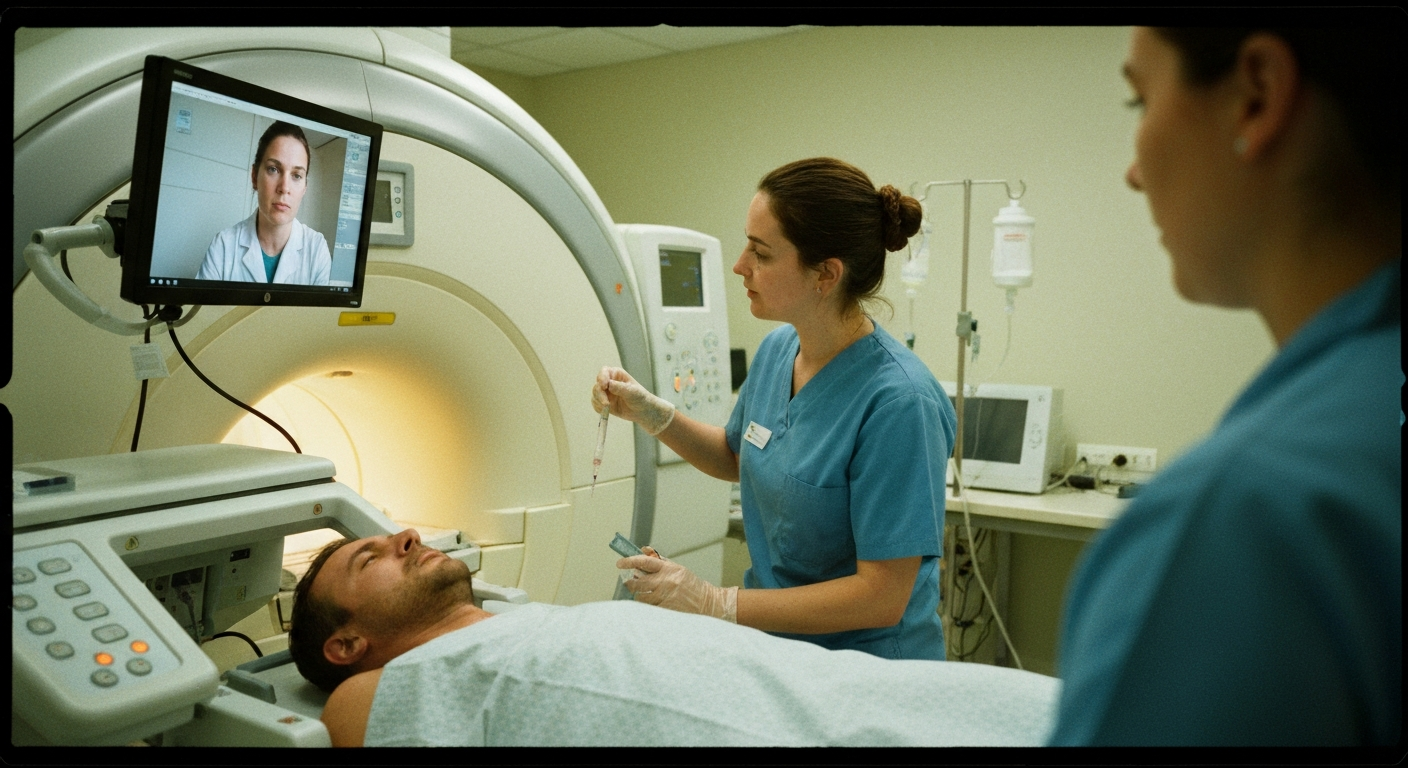
Key Takeaways
- CMS’s permanent virtual direct supervision policy has been in effect since January 1, 2026, and requires real-time, two-way audio-video communication; audio-only communication does not meet the standard
- Supervising physicians must remain immediately available throughout the entire service, even when they are offsite rather than physically present
- Contrast administration carries its own separate safeguards on top of the CMS rule, including a requirement that only a physician – not another remote practitioner – supervise qualified on-site staff virtually
- On-site teams need at least one licensed practitioner trained to recognize adverse reactions and respond to emergencies, regardless of how supervision is delivered
- Radiologist workforce trends are adding pressure on imaging centers to build compliant, well-documented virtual supervision workflows, a topic worth reviewing closely for any center managing Medicare compliance
Imaging centers have spent years navigating pandemic-era flexibilities and evolving requirements for contrast supervision. CMS’s permanent virtual direct supervision policy, effective January 1, 2026, establishes a clearer framework for applicable services. However, the policy governs supervision technology, not the separate clinical safeguards that apply to contrast administration. Imaging center administrators must understand how these requirements work together to maintain compliant workflows.
CMS’s Permanent Virtual Supervision Policy
Since January 1, 2026, CMS has permitted direct supervision to be satisfied through real-time audio and visual interactive telecommunications for applicable diagnostic tests and other covered services. This permanent provision under 42 CFR § 410.32 provides a regulatory framework for imaging centers evaluating supervision arrangements, staffing requirements, and technology planning.
The policy also has specific limitations. Services with a 010 or 090 global surgery indicator still require physical, on-site supervision, meaning virtual options are not a blanket substitute across every service line. Administrators must check each covered service against its supervision category rather than assuming virtual coverage applies universally.
ContrastConnect, a Las Vegas, Nevada-based virtual contrast supervision provider, notes that understanding the distinction between eligible services and those requiring physical supervision is essential for imaging centers assessing virtual coverage. Its guidance on CMS rules and ACR guidelines for virtual contrast supervision explains the policy’s scope alongside contrast-specific safeguards and compliance considerations.
What Qualifies as Virtual Direct Supervision
Not every video call or check-in qualifies as compliant supervision. CMS’s permanent policy establishes specific technical and availability standards, and failing to meet either requirement can create compliance exposure—even when a physician is reachable during the procedure.
Real-Time Audio-Video Required, Audio-Only Does Not Qualify
The permanent rule requires real-time, two-way audio and visual interactive telecommunications. Phone calls, voicemail check-ins, or any audio-only arrangement fail to meet the standard, no matter how quickly the physician responds. The supervising physician or practitioner must also remain available throughout the entire performance of the service, which means stepping away mid-procedure, even briefly, can break compliance. Imaging centers should treat the technology standard as a floor, confirming that cameras, microphones, and connections perform reliably under real clinical conditions rather than only during a one-time setup test.
Services Still Requiring On-Site Presence
Services carrying a 010 or 090 global surgery indicator remain excluded from virtual supervision, meaning a physician must be physically present in the office suite for those procedures. CMS’s virtual supervision policy does not eliminate the need to determine, service by service, whether direct supervision applies at all or whether an exclusion already governs the situation. Administrators should keep an updated internal reference of which services fall under which supervision category, since misclassifying even one service line can create compliance risk during a Medicare audit.
Contrast Administration Has Separate Safeguards
Qualifying under CMS’s virtual supervision rule is only half the compliance picture for contrast-enhanced imaging. Contrast administration carries its own layer of clinical safeguards, grounded in guidance separate from the CMS telecommunications standard, and both must be satisfied together.
Only a Physician May Supervise Virtually
For contrast administration, direct supervision is required, and virtual supervision of qualified on-site personnel should be performed only by a physician. This narrows who can sit on the other end of that video connection. A radiology assistant or other non-physician practitioner working remotely cannot serve as the virtual supervisor for contrast administration, even if that same individual might be permitted to supervise certain other services under the broader CMS framework.
One Supervisory Level, Direct Bidirectional Communication
Virtual contrast supervision should involve only one supervisory level. An off-site physician should not virtually supervise another off-site licensed practitioner, technologist, or nurse who is, in turn, responsible for the patient on-site. Instead, the off-site physician must communicate directly and bidirectionally with the on-site person responsible for the patient’s safety and positioning during the study. Stacking supervisory layers introduces delay and confusion exactly when immediate response matters most, so keeping this chain flat and direct is a core safeguard rather than a formality.
On-Site Personnel Standards for Contrast Safety
Technology alone does not make a contrast workflow safe. The people physically present in the room carry responsibilities that no camera or microphone can substitute for, and CMS’s permanent rule does nothing to lower that bar.
Licensed Practitioner Competency Requirements
On-site personnel beyond the technologist must include at least one licensed practitioner meeting specified training and competency requirements. This person must be able to recognize adverse reactions and administer permitted medications or interventions without waiting for extended direction. A fully qualified technologist licensed in the jurisdiction where the study is performed must also remain in direct control of the scanner, whether that scanner is operated on-site or remotely. These requirements exist independently of whichever supervision model a facility chooses, meaning staffing plans cannot shortcut licensed-practitioner coverage simply because a physician is available by video.
Preparing for Adverse Reactions and Emergencies
Emergency-response readiness includes knowing when to seek assistance and activate emergency systems, not just having equipment present in the room. Remote scanning does not change a facility’s responsibility to prepare independently for contrast-management, reaction, CT-safety, and MR-safety emergencies. Overall staffing should account for how quickly emergency response systems are available when contrast is administered under remote general supervision, since a few seconds of delay can matter significantly during a severe reaction. Regular review of emergency protocols, medication stock, and equipment readiness should happen on a predictable schedule rather than only after an incident prompts a reassessment.
Why Radiologist Workforce Trends Raise the Stakes
These compliance requirements remain relevant as imaging centers navigate ongoing radiologist workforce constraints. Workforce research published in the Journal of the American College of Radiology in August 2026 found that U.S. radiology residency positions increased by 33% from 2010 to 2025, while the practicing radiologist workforce grew by only 12% from 2010 to 2022. That gap between training capacity and actual workforce growth signals a tightening supply of radiologists available for traditional on-site coverage.
As that gap persists, imaging centers face pressure to extend limited radiologist availability across more locations and longer hours without compromising supervision quality. Virtual direct supervision offers one path to stretch that coverage, but only when paired with the clinical safeguards contrast administration demands. A facility that treats virtual supervision purely as a staffing fix, without also investing in on-site practitioner competency and emergency readiness, builds a workflow that looks efficient on paper while carrying real safety gaps.
Two Rules, One Compliant Contrast Workflow
Running a compliant contrast program in 2026 means satisfying two separate frameworks at once. CMS’s permanent rule sets the technology and availability bar for virtual direct supervision generally: real-time, two-way audio-video, no audio-only substitutes, and continuous physician availability. Contrast administration then layers on its own requirements, including physician-only virtual supervision, a single supervisory level with direct communication, and on-site licensed-practitioner competency backed by genuine emergency preparedness.
Treating these as one combined checklist, rather than two separate boxes to tick, separates a defensible compliance program from one that merely looks compliant on the surface. Administrators who document how each requirement is met, from the physician’s qualifications to the technologist’s licensure to the facility’s emergency drills, put themselves in a stronger position during any Medicare review. For imaging centers mapping out next steps, a closer look at virtual contrast supervision requirements can help clarify where current workflows already meet the standard and where gaps still need attention.
ContrastConnect
Las vegas
Las Vegas
NV
89109
United States